Turn 1 vs Turn 3 Solitaire: Which Is Harder?
By Sam Ashford - Last Updated: 12/07/2026
Turn 3 Solitaire is significantly harder than Turn 1, with win rates around 10-15% compared to Turn 1's 30-35%. The difference comes down to card access. When you draw three cards at a time, you can only use the top card unless you play the ones above it first. This limits your options and requires more planning.
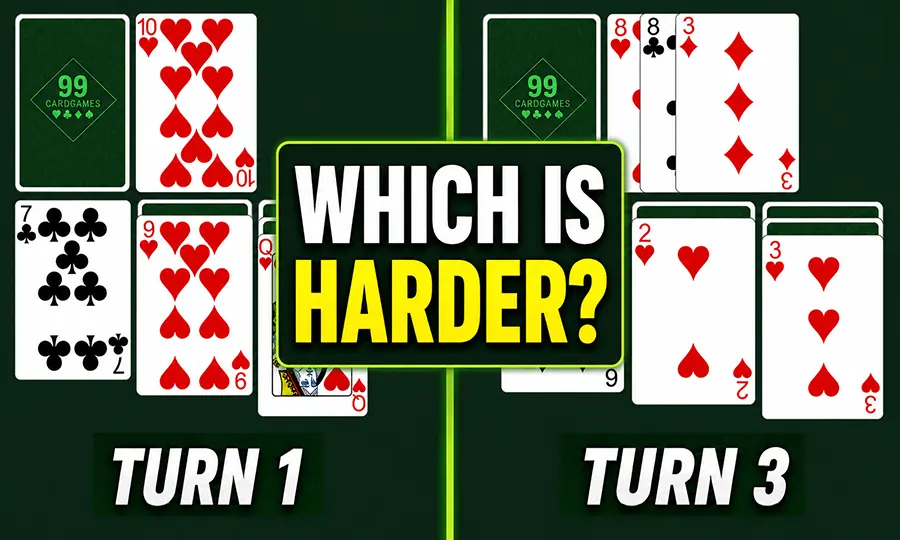
Turn 3 forces you to think several moves ahead because many cards stay buried in the deck, while Turn 1 lets you see and use every card as it comes up.
Both versions follow the same basic rules of Klondike Solitaire, but the way you draw from the deck changes everything about how you play. Your strategy needs to adapt based on which version you choose. Understanding the specific challenges of each mode will help you pick the right one for your skill level and decide where to focus your practice time.
Understanding Solitaire Turn Rules
When you play Klondike Solitaire, the turn rule controls how many cards you draw from the stock pile at once. This single rule change creates two different game experiences.
Turn 1 (Draw 1) means you flip one card at a time from the stock pile. You can play each card immediately if it fits on the tableau or foundation. If you can't use it, the card goes to the waste pile, and you draw the next one.
Turn 3 (Draw 3) means you flip three cards at once from the stock pile. Only the top card of those three is available to play. The other two cards stay hidden underneath until you play or move the top card.
Here's how the rules compare:
| Feature | Turn 1 | Turn 3 |
|---|---|---|
| Cards drawn | 1 at a time | 3 at a time |
| Cards available to play | Every card | Only the top card |
| Access to stock | Immediate | Restricted |
The turn rule affects everything about your game. In Turn 1, you see every card in your stock pile on each pass through the deck. In Turn 3, some cards stay buried under others, which limits your options.
Most digital solitaire games let you choose between Turn 1 and Turn 3 before you start. The core rules for building tableau columns and foundation piles stay the same. Only the stock pile drawing method changes.
Impact On Strategy And Decision-Making
The way you approach each game changes completely based on whether you play Turn 1 or Turn 3. In Turn 1, you can see every card in the stock pile one at a time. This means you make decisions based on complete information about what's available.
Turn 3 forces you to think several moves ahead. You need to track which cards will appear on top when you cycle through the deck. Missing a key card buried under two others can cost you the game.
Key strategic differences include:
- Card tracking: Turn 3 requires you to memorize card positions in groups of three
- Tableau planning: You must consider whether moving a card now will block access to cards underneath it later
- Stock management: In Turn 3, you decide whether to cycle through the deck or make tableau moves first
- Risk assessment: Turn 1 lets you play more conservatively since cards are always accessible
Turn 1 rewards careful observation and patience. You can wait to see what cards appear before committing to moves. Turn 3 demands you commit to sequences earlier with less information.
The stock pile becomes a puzzle in Turn 3. You calculate whether the card you need will land on top after your next pass through. In Turn 1, this calculation doesn't exist.
Your decision tree expands in Turn 3 because you evaluate not just the current board state but future card availability. This added layer makes every move more consequential.
Difficulty Factors For Turn 1 Play
Turn 1 solitaire draws one card at a time from your stock pile. This gives you access to every card in order, which makes the game more forgiving than Turn 3.
Card Access and Visibility
You can see each card as it comes up in the deck. This means you won't miss playable cards or lose track of important cards buried in groups of three. You have complete control over which cards you use and when.
Decision-Making Complexity
Turn 1 requires fewer advanced planning skills. You don't need to calculate which cards will appear on top of future draws. Your decisions focus on whether to play a card now or save it for later.
Main Challenge Areas:
- Timing decisions - Choosing when to move cards from the stock versus the tableau
- Foundation building - Deciding which suits to prioritize
- Column management - Creating empty spaces and organizing sequences
- Undo temptation - Having full card access can lead to overthinking moves
Win Rate Impact
Your real-world win rate in Turn 1 sits around 30-35% for most players. This is significantly higher than Turn 3, where you'll only win 10-15% of games. The higher win rate doesn't mean the game is trivial, though.
The difficulty in Turn 1 comes from optimizing your moves rather than fighting against limited card access. You need to think about the best sequence of moves, not just whether moves are possible.
Challenges Unique To Turn 3 Play
Turn 3 solitaire presents obstacles you won't face in Turn 1. When you draw three cards at a time, you can only access the top card of each group. The other two cards remain hidden until you play or move the top card.
Card Tracking Becomes Critical
You need to remember which cards sit beneath the visible ones in your stock pile. Without tracking these hidden cards, you'll make poor decisions about which moves to prioritize. This mental demand doesn't exist in Turn 1, where every card becomes immediately available.
Limited Stock Access
In Turn 3, some cards become temporarily unreachable. If the card you need is buried under two other cards, you must find a way to play those cards first or cycle through the entire stock. This restriction creates situations where winning moves exist on paper but remain impossible to execute.
Key Difficulties Include:
- Cycling penalties - You may need to go through the stock multiple times to reach buried cards
- Move sequencing - You must plan several moves ahead to expose the cards you need
- Dead ends - Deals can become unwinnable faster because cards get locked behind others
- Pressure on tableau moves - Every foundation and tableau play matters more since stock access is restricted
The win rate reflects these challenges. While Turn 1 has roughly 30-35% winnable deals, Turn 3 drops to just 10-15%. This difference stems directly from the access restrictions that Turn 3 imposes on your stock pile.
Winning Odds And Game Outcomes
Your chances of winning change dramatically between Turn 1 and Turn 3 solitaire. The numbers tell a clear story about which version is harder.
Turn 1 Solitaire gives you a win rate of around 30-35% in real gameplay. Some sources report win rates as high as 33% based on millions of games played. If you play perfectly, about 80% of deals are actually winnable.
Turn 3 Solitaire is much harder to win. Your real-world win rate drops to just 10-15%. The gap between what's possible and what players actually achieve gets wider because you have less control over which cards you can access.
| Version | Real Win Rate | Difficulty Level |
|---|---|---|
| Turn 1 | 30-35% | Moderate |
| Turn 3 | 10-15% | Hard |
The difference comes down to card access. When you draw three cards at once, many cards get buried in the deck. You might never get to play them during that cycle through the stock pile.
Turn 1 lets you see every card one at a time. This means you have more opportunities to make strategic moves and access the cards you need.
Casinos historically preferred Turn 3 for gambling because it's harder to beat. The lower win rate made it better for the house.
Skill Versus Luck In Each Variation
Turn 1 Solitaire relies more heavily on skill than luck. You can see every card in the stock pile, which means you can plan your moves ahead of time. About 80% of deals are winnable if you play perfectly.
Your win rate in Turn 1 typically falls between 30-35% with practice. The gap between theoretical wins and actual wins shows how much room you have to improve your strategy.
Turn 3 Solitaire depends more on the initial deal. When you draw three cards at a time, some cards get buried behind others. You might never access certain cards you need, even if you play perfectly.
Key Differences:
- Turn 1: 80% of deals are winnable with perfect play
- Turn 3: Significantly fewer deals are winnable
- Turn 1: Win rates of 30-35% are common
- Turn 3: Win rates typically range from 10-15%
The difference in win rates reveals how much control you actually have. In Turn 1, you lose most games because of mistakes you could have avoided. In Turn 3, you lose most games because the cards simply weren't accessible.
Both versions require skill to maximize your chances. Turn 3 players need to think several moves ahead and make careful choices about which cards to play. But even expert players face more unwinnable deals in Turn 3.
Your skill matters in both versions, but it has more impact on your results in Turn 1.
Frequently Asked Questions
The draw setting affects how many cards you flip from the stock pile at once. This single rule change impacts win rates, strategy depth, and overall difficulty.
What is the difference between Draw 1 and Draw 3 in Klondike Solitaire?
Draw 1 lets you flip one card at a time from the stock pile. You can access every card in the stock with enough cycles through the deck.
Draw 3 flips three cards at once, and you can only play the top card. This means some cards in the stock become trapped behind others. You cannot access every card unless you remove the ones covering them.
Which draw setting is more difficult for most players, and why?
Draw 3 is harder because it limits which cards you can access. When you flip three cards, the bottom two cards stay hidden until you play or move the top card.
This restriction reduces your options during gameplay. Many cards become unreachable, making it impossible to win certain deals that would be winnable in Draw 1.
The reduced access to stock cards forces you to plan ahead more carefully. You need to think about card order and avoid blocking cards you might need later.
How do the rules for cycling through the stock and waste differ between Draw 1 and Draw 3?
Both versions let you cycle through the stock pile multiple times. When you reach the end of the stock, you flip the waste pile over to create a new stock.
In Draw 1, you see one new card each time you draw. In Draw 3, you see up to three cards, but only the top card is playable.
The cycling rules stay the same, but Draw 3 creates gaps in accessibility. Cards in the second and third positions remain blocked until you remove cards above them.
Does Draw 3 reduce the win rate compared to Draw 1, and by how much on average?
Draw 3 significantly lowers your win rate. Draw 1 has a win rate around 30-35% for most players. Draw 3 drops to approximately 10-15%.
The difference comes from card accessibility. About 80% of Draw 1 deals are theoretically winnable with perfect play. Draw 3 makes many deals unwinnable regardless of skill level.
What strategies help improve winning chances when playing Draw 3 Solitaire?
Focus on building tableau columns before drawing from the stock. Empty columns give you more flexibility to move cards and access blocked stock cards.
Avoid playing cards from the stock too quickly. Think about what cards might be trapped underneath and whether you need them later.
Prioritize moves that reveal face-down tableau cards. These moves give you new options and help you avoid dead ends in the stock pile.
What are the standard rules for moving cards between the tableau, foundations, and waste in Klondike Solitaire?
You can move cards from the waste pile to either the tableau or foundations. Cards in the tableau must alternate colors and descend in rank.
Foundations build up by suit from Ace to King. You can move cards from the tableau to foundations when they match the suit and follow the sequence.
Only Kings can fill empty tableau columns. You can move sequences of face-up cards together between tableau columns if they follow the alternating color rule.