Report bug
Tell us what went wrong, and what you expected to happen.
Bookmark us
Save 99CardGames to your bookmarks so you can get back to your favourite card games quickly.
How to Play FreeCell
FreeCell is one of the most skill-based solitaire games you can play because every card is visible from the very start. There are no hidden tableau cards to reveal and no stockpile to draw from, which means nearly every decision comes down to planning, structure, and move order. If you enjoy solitaire games that reward careful thinking more than luck, FreeCell is one of the best formats to learn.
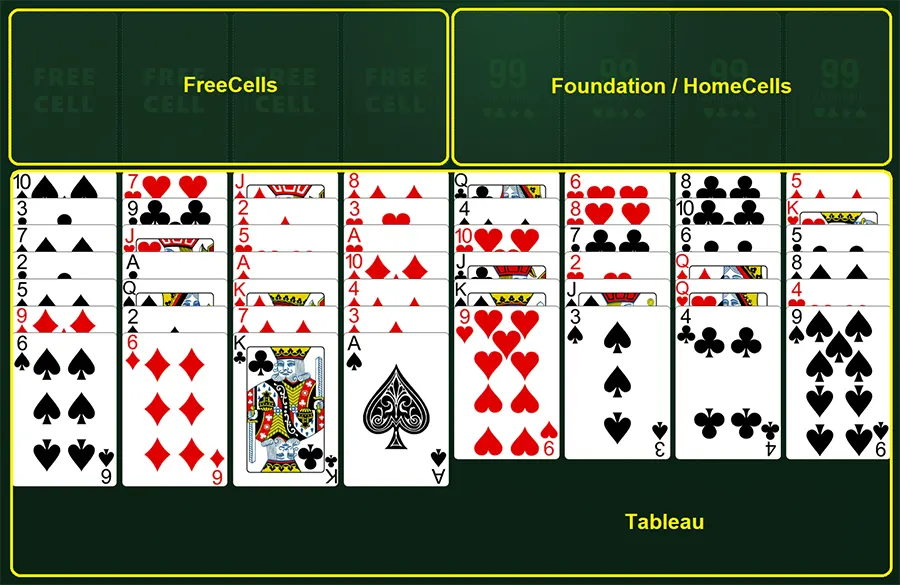
On 99CardGames, you can play FreeCell online for free in your browser without downloading anything or creating an account. The game loads quickly, works across desktop and mobile devices, and keeps the classic layout players expect: four Free Cells at the top left, four Foundations at the top right, and eight tableau columns underneath.
What makes FreeCell stand out from other solitaire games is that the challenge comes from control rather than mystery. You already know where every card is. Winning depends on how well you use temporary storage, how carefully you open empty columns, and whether you can keep the tableau flexible enough to rearrange long sequences.
Objective
The objective in FreeCell is to move all 52 cards to the four Foundations, building each suit upward from Ace through King. At the same time, you use the eight tableau columns to organize cards in descending order with alternating colours, while the four Free Cells act as temporary holding spaces for single cards.
Because all cards are dealt face up at the beginning, the game often feels more like solving a puzzle than uncovering a random layout. A strong FreeCell player is not just looking for the next legal move. They are trying to create space, preserve options, and keep future sequences movable.
Game areas
The FreeCell layout is simple, but each area has a very specific role. Learning what each part of the board is for will help you make better decisions and understand why some apparently legal moves still weaken your position.
- Free Cells: the four spaces at the top left. Each Free Cell can hold one card at a time and is mainly used to create breathing room while reorganizing the tableau.
- Foundations: the four spaces at the top right. Each Foundation begins with an Ace and builds upward by suit until all cards are home.
- Tableau: the eight columns below. Cards build downward in alternating colours, and most of the strategy happens here.
- Empty columns: an empty tableau column is not just open space. It is one of the strongest tools in FreeCell because it increases how many cards you can move in a single sequence.
Why FreeCell is different
Many solitaire games mix skill with hidden information. In Klondike, for example, some of your planning depends on which face-down cards are waiting underneath the tableau. FreeCell removes that uncertainty. Since every card is visible, most losses come from inefficient sequencing or from locking important cards behind a structure that becomes difficult to break apart later.
That visibility is why FreeCell has a reputation for being one of the fairest and most winnable patience games. When a deal looks impossible, it is often because the right route is still hidden inside the layout, not because the game withheld information from you. For many players, that makes FreeCell deeply satisfying to practice.
History of FreeCell
FreeCell belongs to the wider family of patience and solitaire card games that developed long before computers. However, the version most people know today became especially popular through digital play, particularly when Microsoft included FreeCell with Windows. That release introduced millions of players to a more strategic alternative to Klondike Solitaire.
Its popularity grew quickly because it felt different from the standard solitaire game people were used to. Instead of repeatedly clicking through a stockpile, players had direct access to the full deal and could focus on logic, ordering, and efficiency. Over time, FreeCell became one of the best-known solitaire variants in its own right rather than just a side option beside Klondike.
Why is it called FreeCell?
The name comes from the four open temporary spaces used during play. These cells are "free" because they can each hold a single card independently of the tableau and the Foundations. They are central to the game because they let you temporarily move a blocking card out of the way, separate parts of a sequence, or prepare a larger transfer between columns.
Although the name sounds simple, the role of the Free Cells is much deeper than basic storage. New players often fill them too quickly, while stronger players treat them as a limited resource that should be spent carefully and recovered whenever possible.
Rules
The core rules of FreeCell are easy to understand, but mastering them depends on seeing how they connect. A move that looks harmless in isolation can reduce your capacity to move entire sequences later.
- All cards are dealt face up. Nothing is hidden in the tableau, so every decision can be based on visible information.
- Build tableau columns down in alternating colours. A black card can go on a red card of the next higher rank, and a red card can go on a black card of the next higher rank.
- Each Free Cell holds one card. These cells are temporary storage spaces, not extra tableau columns.
- Foundations build upward by suit. Aces start the Foundations, then 2, 3, 4, and so on up to King.
- Only legal ordered runs can move together. To move a stack, the cards must already be in descending alternating-colour order.
- Empty tableau columns matter. They can hold any card or valid sequence, and they greatly increase your maximum movable stack size.
- Move capacity depends on space. The number of cards you can move together increases with the number of open Free Cells and empty tableau columns available.
These rules make FreeCell straightforward to learn but deceptively deep. Most of the difficulty comes from using limited space efficiently while keeping the board open for future moves.
Strategy tips
FreeCell rewards patience and clean planning. The strongest moves are often the ones that increase flexibility, not the ones that simply make the tableau look neater for the moment.
- Keep Free Cells open when possible. The more empty Free Cells you have, the more freedom you keep for sequence movement and recovery.
- Do not rush to fill an empty column. An empty tableau column is one of the most powerful tools in the game, so use it intentionally.
- Move Aces and low cards early when safe. Starting the Foundations opens routes for higher cards and can reduce clutter in the tableau.
- Protect move capacity. If all four Free Cells are filled and no columns are empty, your ability to move long sequences drops sharply.
- Think in chains, not single moves. Before moving one card, ask what it unlocks next and whether it improves your long-term structure.
- Use Undo as a study tool. FreeCell is excellent for learning because you can compare move orders and see exactly which decisions reduced flexibility.
How Max Move works
One of the most important concepts in FreeCell is the number of cards you can move together as a group. On this page, the game shows a live Max Move value so you can quickly see your current capacity.
That value depends on two things: how many Free Cells are empty and how many tableau columns are empty. The more space you create, the more cards you can legally transfer as a single ordered stack. This is why experienced FreeCell players often try to keep one or more Free Cells open and treat an empty tableau column as a major strategic advantage rather than just a spare space.
Difficulty and winnability
FreeCell is widely regarded as one of the most winnable solitaire variants because every card is visible and many deals can be solved with correct play. That does not mean every deal is easy. Some layouts require careful move ordering, repeated re-evaluation, and a willingness to delay tempting short-term plays until the board is in a better shape.
The challenge comes from complexity rather than randomness. That makes FreeCell especially appealing to players who enjoy logic-driven games, because improvement feels measurable. As your planning gets stronger, more deals become solvable.
Why play FreeCell online?
Playing FreeCell online gives you the classic rules with the convenience of modern controls. On 99CardGames, you can use Undo, restart quickly, keep saved progress, and play on different screen sizes without installing an app. That makes it easy to study difficult deals, test alternative move orders, and return later if you want to keep working through the same position.
Browser play also makes FreeCell ideal for both short sessions and longer puzzle-solving runs. You can jump in for a few minutes, or you can stay with a challenging layout and work through it carefully at your own pace.
Other games you may like
If you enjoy thoughtful card games, you may also want to try Klondike Solitaire Turn 1, Klondike Solitaire Turn 3, Classic Solitaire Turn 1, or Classic Solitaire Turn 3. Those games add hidden information and stock management, while FreeCell stays focused on visibility, logic, and precise move sequencing.